

Total demand for food is expected to rise by 70 percent by 2050, and at the current rate of growth, humanity will not be able to meet that goal. Demand has outstripped supply since the emergence of China in the mid-1990s. As a result, the agriculture sector has (quietly) outperformed all other sectors except tech since 1999, according to the New York Times. While this is generally true, we’ve seen a downturn in the last 2-3 years due to short-term oversupply causing falling commodity prices. In the midst of this, the industry faces constraints brought on by the depleting availability of land, water and other key resources.
As a result, investors are looking at the twin challenges of productivity and sustainability as they present countless opportunities to innovate from crop inputs, irrigation, transportation, processing, distribution, storage and waste disposal. Despite the fact that the agriculture sector is one of the largest economic sectors in the world, with net farm assets at around $2 trillion, there has been relatively little investment in AgTech compared with other industries. However, given the size of the market, the growth potential and the undeniable need for agricultural innovation to continue to survive, it is expected that investors will soon fully realize the opportunity that AgTech offers.
What AgTech is and Why It’s Gaining Momentum with Investors
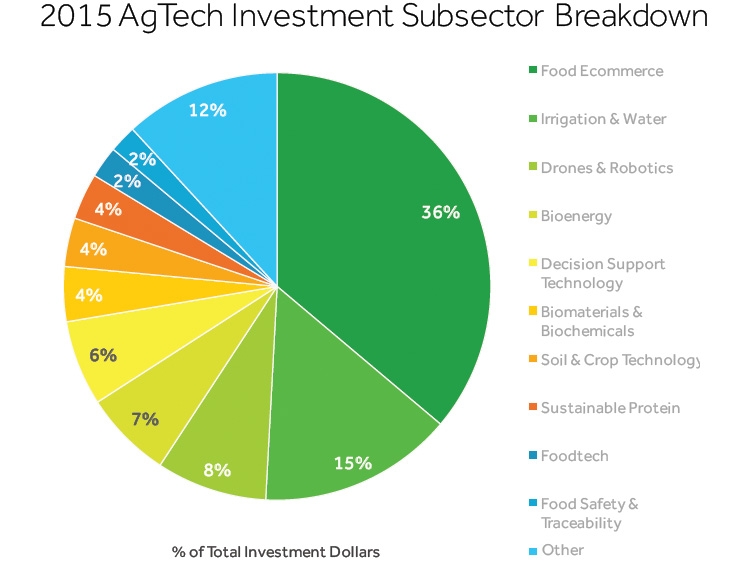
Agtech is a new emerging economic sector that has the potential to “completely reshape global agriculture, dramatically increase the productivity of the agriculture system while reducing the environmental and social costs of current ag practices,” according to “Agtech: Challenges and Opportunities for Sustainable Growth”, a white paper recently published by Ewing Marion Kauffman Foundation.
Humans must find a way to continue producing food despite the planet beginning to show serious signs of environmental stress. The hope of investors and AgTech leaders alike is that new innovations will be essential to helping us rise to the occasion of overcoming monumental global food and farming challenges. With the rise of AgTech startups, the industry is at the frontier of advancements in biotech, biochemistry, satellite, soil microbiome and other decision support technologies across the supply chain and to the farm, according to an article by Brian D Colwell, an Ag investor.
Agribusiness and Big Chemical Corporates Invest in Biotech, Biochemistry

Monsanto Growth Ventures (MGV), the venture capital arm of agribusiness giant Monsanto Co. has invested in nearly a dozen biotech and biochemistry startups from across the world, including participating in a $2.5 million raise for Arvegenix, a leader in the development of Field Pennycress as a significant new crop for the corn-soy growing regions of the world. Pennycress grows over the winter between corn-soy ration, providing growers with an additional revenue crop. Additionally Pennycress oil can be used for aviation fuel and bio diesel.
Along with Avegenix, Monsanto has also invested in an agricultural productivity company called Nimbus-Ceres to develop agricultural fungicides. Nimbus-Ceres combines Nimbus’ agriculture testing capabilities to develop broad-spectrum fungicides. Monsanto is also joining Microsoft in a partnership to invest in AgTech startups in Brazil. Recently, they joined Brazilian investment fund with up to $92 million. Managed by Microsoft, it will evaluate ideas for new digital tools to be applied to agricultural production in the country.
Bayer AG and Dupont have also teamed up to invest in a new fund that will back AgTech startups, pouring millions into the industry as farm profits shrink. The two companies are partnering with venture capital and others to launch a $15 million accelerator fund called “Radicle” that will back early stage AgTech startups.
Plunging Prices and the Impact of Industry Consolidation
While it’s true that agriculture has outpaced other industries in recent years, returns on commodity farmland have declined as grain prices have dropped for the past three years due to short term global oversupply, according to Reuters. Corn futures are down about 40 percent from three years ago due to large global harvests.
Right now, six agricultural companies are merging into potentially the biggest farm business oligopoly in history. Dow and DuPont, fierce US competitors for more than 100 years are merging and will spin off a very large ag-focused company. ChemChina is in the process of acquiring Swiss based Syngenta, and Bayer AG is in the process of merging with Monsanto. These three companies will control half of the world’s seed sales. While consolidation may aid big business, it does not come without risks.
Both anti-trust advocates and farmers are worried about the ‘consolidation crunch’. In a recent September 2016 poll conducted by Farm Journal, 67% of the 2,632 respondents indicated that Bayer’s bid for Monsanto was negative, while just 10% said it was positive. Stakeholders tend to be pessimistic about the possibility of fewer competitors in the market place, according to MizBiz, a west coast business publication.
“It’s not going to be good,” farmer Dennis Heffron said to MiBiz. “I see absolutely no good in it. It’s more consolidation in the industry, and it’s a foreign company that’s going to own it. I have yet to hear any examples of how this is good.”
If you’re in need to a new agribusiness hire, Arris Partners specializes in recruiting for a wide range of agriculture companies and practice areas. Get in touch with us today and we’ll help you find top agriculture talent that will help grow your company.